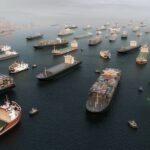
No end in sight to blockade in Hormuz. What happens to your client’s marine coverage now?
With commercial shipping through the Strait of Hormuz at a near standstill, Lloyd’s is expected to consider the area a war risk zone for some time, raising premiums in the marine and cargo line for the foreseeable future.
While shipping through the Strait hasn’t ceased entirely since military action against Iran by the U.S. and Israel began Feb. 28, the number of ships transiting the key waterway has fallen sharply.
“We have had times when some vessels have been able to transit, either because they are turning off their transponders and geolocation, or because they have made some sort of arrangement with the Iranian government,” says Marcos Alvarez, managing director of global financial institution ratings at Morningstar DBRS.
“But definitely, transit has collapsed…they used to have between 121 to 150 crossings per day. Latest number could be 10…,” he tells Canadian Underwriter.
“From an insurance perspective [and] from a shipping perspective, it will be a perilous region for some time. I don’t foresee this trade being excluded from this war risk area by the Joint War Committee of Lloyd’s of London [in] the next few months, which, by definition, makes coverage more expensive, and anything going through that area will require special war risk coverage.”
What’s more, he says, pricing will increase.
“Before this big conflict, we were looking at [around] .25% of the insured value of vessels for hull and machinery [coverage],” Alvarez says, describing it as a “plain vanilla coverage” without which a vessel owner or shipper would not be willing to transit the Strait of Hormuz. “And the latest numbers I’m seeing…[are] something between 7.5% and 10% – an increase of 30 to 40 times.”
Related: Why Iran conflict could recreate COVID-era supply chain problems
And that’s just a single cover. Since cargo insurance typically doesn’t cover war risk, vessel owners and shippers will have to buy separate war risk coverage. “There is less transparency in the market for that type of price, but definitely up multiples since the beginning of the conflict in February,” he says.
In that light, other additional coverages might come into play, including non-damage business interruption in cases where a shipper’s vessel is trapped in the Persian Gulf for an extended period. Such circumstances wouldn’t be covered by war risk or hull and machinery policies.
“There is a loss of use of that vessel for six, eight months and your typical insurance [including cargo] wouldn’t cover that [because there is no policy trigger]….You would need non-damage business interruption [to cover] a contingent loss but basically not having damage. Of course, if the boat is damaged by a rocket or whatever, the war, hull and machinery will cover that. And it might cover the loss of use of that ship if it was struck by a rocket…because there is physical damage.”
Trapped vessels could be carrying perishable foodstuffs that would be lost due to delays. Or they might be carrying something like auto parts that, if a vessel carrying them was trapped for eight months, might not arrive at the factory in time for the current production run.
Related: Where to find commercial cover for wartime risks if the U.S.-Iran ceasefire fails
“The company could be changing models, and you’d get stuck with some older model car components that are going to lose value,” Alvarez says.
Insureds also may need to consider contingent business interruption insurance.
What makes a warranty program built to last?
By
Sponsor Image“Maybe you don’t face a direct loss yourself. You are not even transiting the Strait, but one of your key suppliers might be [which means they’re] not delivering you some goods,” he explains.
“That might be a problem for your supply chain. So you could insure that, but that’s a very special type of supply chain contingent business interruption, which would also require war risk [and] no damage.”
This article is excerpted from one that appeared in the October 2026 print edition of Canadian Underwriter.