Industry projects Eastern Canadian ice storm to be a Cat event
A large ice storm sweeping through Ontario, Quebec and the Maritimes is expected to be declared a natural catastrophe (Cat) event, sources tell Canadian Underwriter.
“In my view, this will likely be deemed a Cat by CatIQ (i.e. insured losses greater than $30 million),” Institute for Catastrophic Loss Reduction managing director Glenn McGillivray tells CU Monday in an emailed comment. “While the storm has largely spared big urban centres in Ontario, it has impacted several smaller cities and towns, with Orillia, District of Muskoka, Oro-Medonte, Peterborough and possibly others declaring states of emergency.
“The storm has moved east into Quebec and New Brunswick. It’s not clear if there is damage there, too, and whether this will all be considered one event…All in all, this will likely be a case of a significant number of smallish claims being filed, which can add up when a storm covers a wide geographic area like this one.”
CatIQ director Caroline Floyd says her firm has not yet formally surveyed its insurance company members about claims numbers. She provided CU with three different past ice storm Cat events as potential comparison points.
For example, she notes an ice storm in December 2013 did about $200 million damage (unadjusted for inflation) from Ontario to Atlantic Canada. In a second example, a stronger storm in April 2023 dumped 37 mm of freezing rain in Montreal and caused flooding in southwest Ontario, resulting in about $315 million in damage. And finally, an April 2018 storm saw some flooding in southwestern Ontario and around 20 hours of freezing rain in southwestern Quebec, resulting in about $250 million in damage (unadjusted).
“In terms of number and extent of power outages, at present I would say this event looks most similar to the 2018 one,” Floyd tells CU. “Although, it’s worth noting the 2018 storm impacted the GTA (Greater Toronto Area) more directly, whereas this storm’s heaviest impacts look to be slightly to the east and in somewhat more rural locations.
“The bigger winter storm Cats are the ones that impact Toronto and/or Montreal, though, as one might expect.”
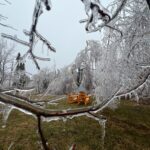
This weekend’s ice storm passed through central and eastern Ontario, causing widespread power outages affecting more than 400,000 Hydro Ontario customers. Heavy ice accumulations snapped tree branches, causing them to hit and break power lines.
Forecasted winds of 50 km/h in some affected areas Monday is expected to hamper hydro wire repairs, with Hydro One reporting power won’t be restored in some areas until Tuesday, Wednesday, or Thursday.
“Peterborough and Trenton endured more than 30 hours of freezing rain between Friday night and Sunday,” The Weather Network reported Monday. “Folks around Ottawa saw more than 13 hours of freezing rain — and that arrived after a blanket of snow earlier in the storm.”
Environment Canada initially issued a freezing rain warning for Montreal, but dropped it this morning when it appeared the precipitation would hit western and central parts of Quebec instead. Freezing rain warnings have been issued for most Atlantic provinces.
“We’re receiving calls about claims and from clients who are unsure about what storm-related damage their insurance covers,” says Adam Mitchell, CEO of Mitch Insurance.
The brokerage has taken calls about fallen trees and branches damaging homes, detached structures like sheds and gazebos, and vehicles, Mitchell says. Also, the brokerage has received reports of downed power lines on clients’ property, food spoilage, and power outages causing sump pumps to fail, causing water damage to their basement.
“We’re also getting calls from clients with questions about additional living expenses and whether they have coverage for this due to the power outage,” Mitchell says. “However, additional living expenses doesn’t apply unless there is physical damage to their property that caused the outage.”
Additionally, Mitch is reporting instances of binding authority restricted by some carriers for certain areas, such as Peterborough and Orillia, that were hard hit by the ice storm.
In other news: Intact bullish on brokerage M&A in Canada
Greg Smith, president at Crawford & Company (Canada) Inc., says his adjusting firm has seen some claims reported from the ice storm event, “but not abnormally high volumes.”
But the nature of this storm may cause delays in claims reporting, he adds.
“Power outages impacted a wide area of the province over the weekend and continue today as crews work to restore power,” Smith tells CU. “This will result in claims related to the power outage such as spoiled food in refrigerators and freezers and potentially water damage caused by sump-pump failures.
“There is often a lag in receiving those claims as power must first be restored before they can be reported. With many seasonal properties in the region, some damages may not be discovered immediately.”
Some commercial policies may be impacted as well, McGillivray notes.
“Businesses could possibly file claims for disruption due to power outages, but they generally must have Off Premise Power coverage in place, and I believe that many won’t have this coverage,” McGillivray says. “Companies that do will likely face what amounts to be a deductible or waiting period of up to several days with no power before they can make a claim (there may be other restrictions on the policy too).”
Off-premises utility coverages are endorsements to existing policies, as Aegis Insurance explains on its website. “Off-Premises Utility coverage helps businesses by providing financial support when losses occur due to a covered event causing an off-site outage to a major utility, like water, power, or telecommunications. Covered events that can cause off-site outages include fires, lightning strikes, explosions, windstorms, or hail.”
The endorsement “can help with property damage, revenue losses, and additional expenses that arise from the utility disruption,” Aegis states.
Photo Credit: Ice covered trees branches are shown in Meaford, Ont., Sunday, March 30, 2025. More than 200,000 Ontarians are without power as this weekend’s ice storm moves east, threatening parts of New Brunswick and Prince Edward Island.THE CANADIAN PRESS/HO-Becky Holvik